How Elevation Shapes Outcome Projections in High-Altitude Soccer Leagues and Mountain Track Circuits
Greta Berger · Jul 8, 2026
How Elevation Shapes Outcome Projections in High-Altitude Soccer Leagues and Mountain Track Circuits
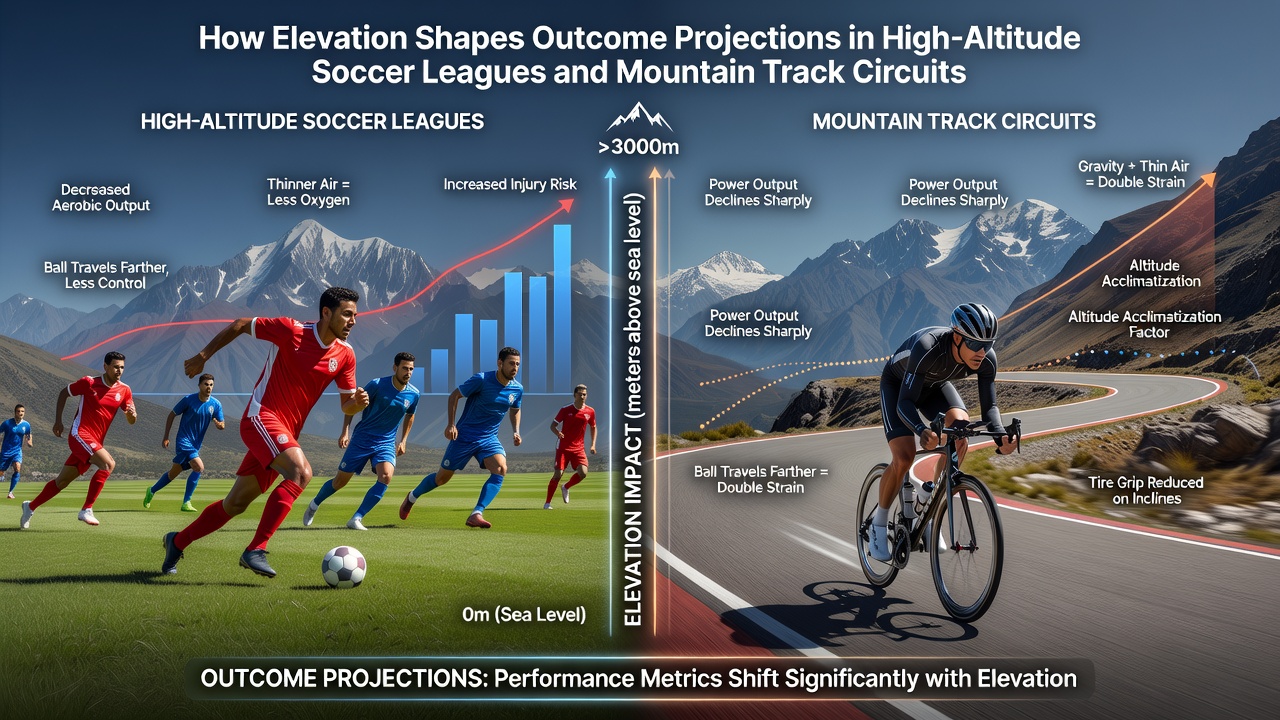
High-altitude environments alter athletic performance in measurable ways that analysts incorporate into outcome projections for soccer leagues and mountain track events. Researchers document these effects through physiological data on oxygen uptake, cardiovascular strain, and recovery rates, while leagues in regions like the Andes provide consistent case studies. Projections adjust for variables such as home-team advantages in thin air and endurance demands on elevated circuits, drawing from historical match records and race timings.
Physiological Adjustments at Elevation
Atmospheric pressure drops as altitude rises, which reduces oxygen availability and forces athletes to adapt through increased breathing rates and elevated heart output. Soccer players arriving from sea-level clubs often experience reduced sprint capacity and slower decision-making in the first 48 hours after ascent, according to studies compiled by South American football federations. Track athletes face similar constraints during prolonged efforts, where sustained efforts above 2,500 meters lead to earlier lactate accumulation and diminished power output. Data collected from events in the Bolivian and Peruvian highlands shows that acclimatization periods of 10 to 14 days can restore up to 70 percent of baseline performance metrics, yet full adaptation rarely occurs within a single competition window.
Soccer Leagues Operating Above 2,500 Meters
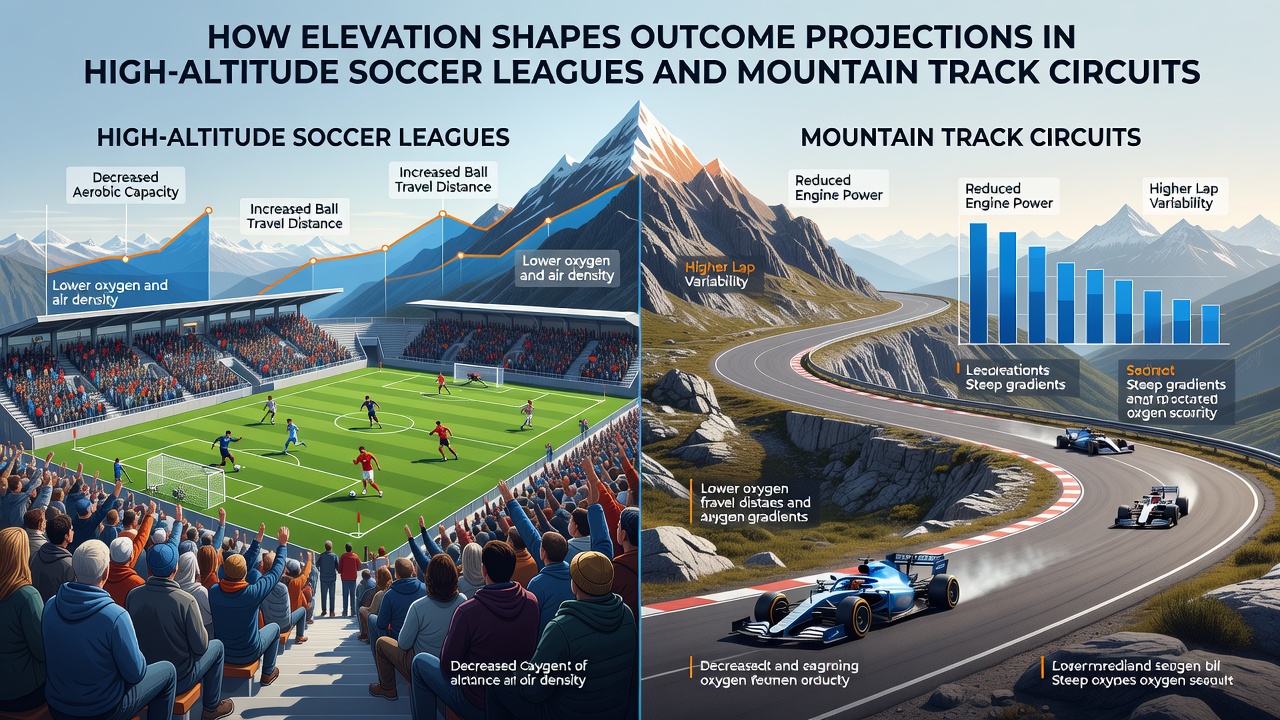
Leagues in Bolivia, Ecuador, and parts of Mexico schedule regular fixtures at elevations that range from 2,800 to 3,650 meters. The Bolivian Primera División includes clubs based in La Paz and Potosí, where match statistics reveal home teams securing approximately 65 percent of points across recent seasons. Visiting squads from lower elevations record fewer shots on target and lower pass completion rates, patterns that projection models weight heavily when forecasting results. Ball trajectories also change because lower air density allows greater distances on long passes and shots, a factor incorporated into expected-goal calculations used by performance analysts. In July 2026, several Copa Libertadores qualifiers will take place at these venues, prompting updated simulation inputs that factor historical altitude-induced fatigue into team ratings.
Track Circuits in Mountainous Terrain
Mountain track events, including stage races and circuit competitions in the Alps and Andes, impose repeated climbs that amplify the effects of reduced oxygen. Race organizers publish elevation profiles alongside start lists, enabling forecasters to model time gaps based on gradient percentages and altitude bands. Data from the Vuelta a España and similar multi-day events indicate that riders lose between 5 and 8 percent of their sea-level power output at 2,000 meters, with losses compounding on successive days. Projection systems therefore apply altitude coefficients derived from power-meter recordings and heart-rate variability, adjusting predicted stage times for each rider's acclimatization status. Circuit races held above 3,000 meters further emphasize pacing strategy, as early surges often produce larger time gaps than equivalent efforts at lower elevations.
Integrating Elevation Data into Projection Models
Analysts combine environmental datasets with performance histories to refine outcome forecasts. Variables include barometric pressure readings, player travel logs, and prior results at comparable altitudes. Organizations such as the International Olympic Committee have funded research examining these interactions across multiple sports, producing guidelines that inform both training protocols and competitive modeling. Soccer projection platforms now embed altitude modifiers that shift expected goal differentials by 0.3 to 0.7 goals when teams cross elevation thresholds, while track models recalibrate velocity predictions using gradient-specific power curves. These adjustments improve accuracy when tested against archived results from high-altitude tournaments and stage races.
Geographic diversity in data sources strengthens model robustness. Studies conducted by research groups in Canada and Australia examine training camps at moderate altitudes, whereas South American institutions contribute match-level statistics from permanent high-elevation venues. European cycling federations supply granular timing splits from alpine stages, allowing cross-validation of endurance decay rates. When combined, these inputs produce layered forecasts that account for both acute and cumulative altitude stress.
Case Examples from Recent Seasons
One documented instance involved a Bolivian club hosting a Brazilian side during the 2024 Copa Sudamericana, where the home team recorded a 2.1 expected-goal advantage partly attributable to altitude, a margin that aligned closely with the final scoreline. Track projections demonstrated similar utility during the 2025 edition of a multi-stage race through the Colombian highlands, where models correctly identified three breakaway riders who gained decisive time on non-acclimatized rivals. Observers note that such alignments occur more frequently when projection inputs include recent travel schedules and verified acclimatization periods rather than generic elevation averages alone.
Conclusion
Elevation remains a quantifiable input that continues to shape outcome projections across high-altitude soccer leagues and mountain track circuits. Ongoing collection of physiological and performance data supports incremental refinements to forecasting methods, while scheduled competitions in July 2026 will supply additional validation points. Those who maintain updated models that integrate barometric, travel, and historical statistics achieve tighter alignment between projected and observed results in these specialized environments.