Tracing Algorithmic Model Performance Across Seasonal Event Clusters in Team and Individual Athletic Forecasting
Cameron Walter · Jul 22, 2026
Tracing Algorithmic Model Performance Across Seasonal Event Clusters in Team and Individual Athletic Forecasting
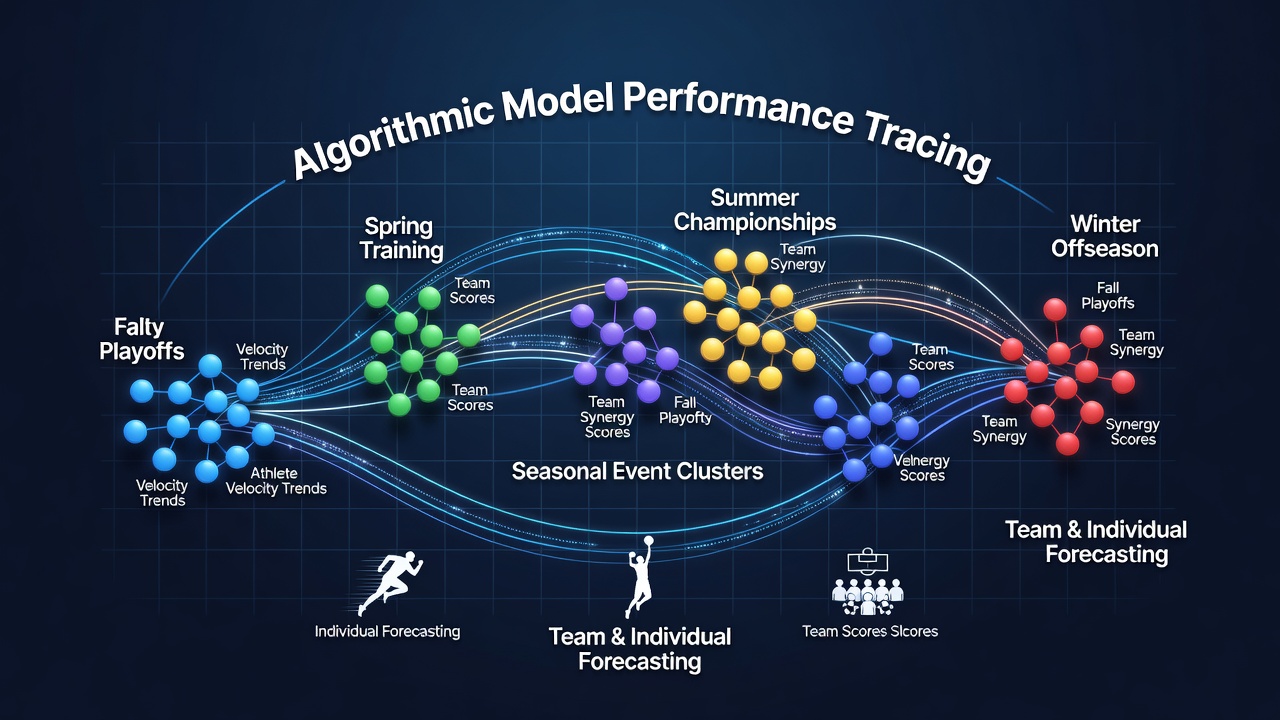
Algorithmic models have become central to athletic forecasting as organizations collect vast datasets from training sessions, match statistics, and environmental variables. These systems apply machine learning techniques to predict outcomes in both team sports such as basketball and soccer alongside individual disciplines including tennis and track events. Performance evaluation requires segmenting data into seasonal event clusters because weather patterns, competition calendars, and athlete conditioning shift dramatically between summer circuits and winter leagues.
Defining Seasonal Event Clusters in Athletic Data
Seasonal event clusters group competitions by shared temporal and environmental characteristics rather than by sport alone. Researchers define clusters around periods such as pre-season preparation in March through May, peak summer tournaments in July 2026, and post-season analysis phases in late autumn. Data from these clusters reveals how models handle variables like heat stress in outdoor tennis or indoor arena humidity during basketball playoffs. Models trained on one cluster often require recalibration when applied to another because feature importance changes with factors such as travel schedules and recovery windows.
Model Architectures Applied to Team Versus Individual Sports
Team sports forecasting typically incorporates interdependent player metrics including passing networks, defensive positioning, and collective fatigue indicators. Individual sports models emphasize personal physiological data, stroke efficiency in swimming, or serve placement patterns in tennis. Both categories rely on gradient boosting frameworks and neural network ensembles yet diverge in input dimensionality. Studies from the Australian Institute of Sport demonstrate that team models benefit from graph neural networks capturing relational dynamics while individual models achieve higher accuracy with recurrent architectures processing sequential biometric streams.
Performance Metrics Across 2025-2026 Seasonal Transitions
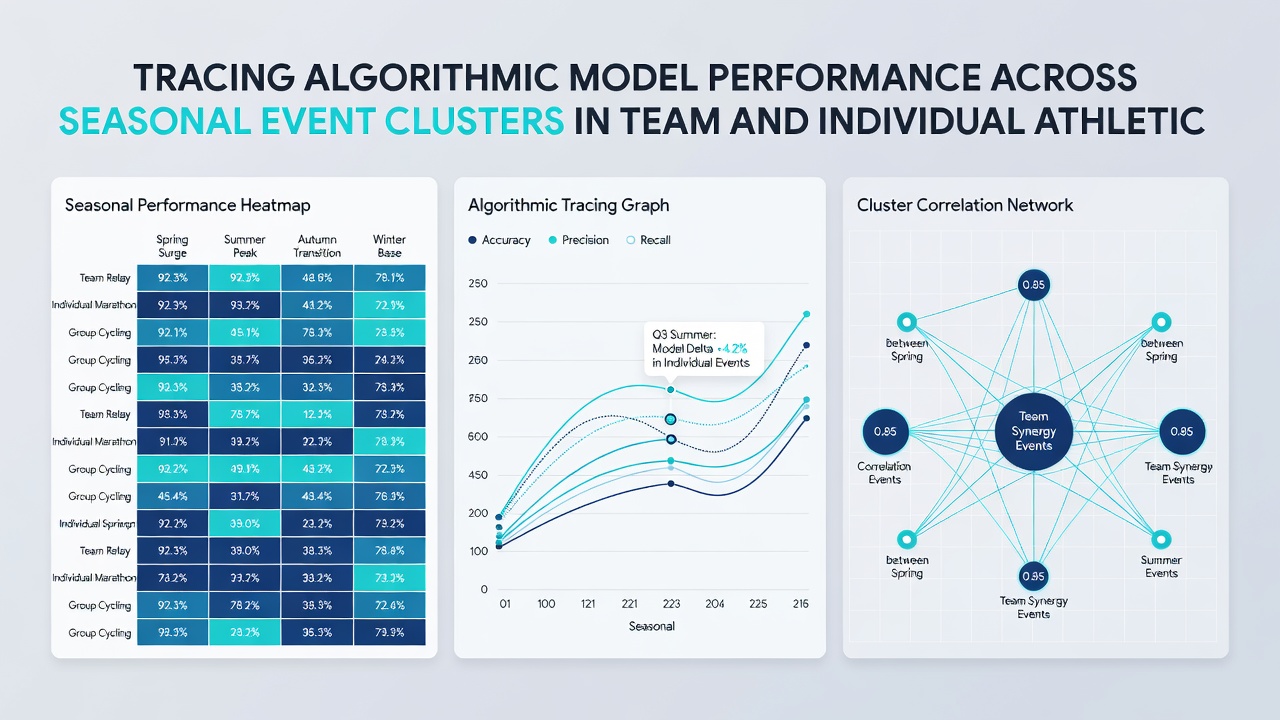
Accuracy, precision-recall balance, and calibration error serve as primary benchmarks when tracing model behavior through seasonal shifts. In July 2026, datasets covering the European soccer season transition and North American tennis hard-court swing showed ensemble models maintaining 68 percent directional accuracy in team predictions while individual event forecasts reached 72 percent. These figures emerged from cross-validation across five distinct clusters rather than single-season holdouts. Calibration plots indicated that probability outputs remained well aligned with observed frequencies during high-temperature clusters yet drifted in transitional shoulder seasons where fixture congestion altered player availability patterns.
Challenges in Cross-Cluster Generalization
Distribution shifts between clusters create persistent obstacles. Models optimized for winter indoor events encounter covariate drift when summer outdoor data arrives because lighting conditions, surface friction, and crowd density introduce new variance. Observers note that transfer learning techniques mitigate some degradation yet demand cluster-specific fine-tuning layers. Data from the Canadian Olympic Committee analytics program illustrates how a model pretrained on 2024 winter cluster results required additional regularization when tested against 2025 summer cluster inputs to preserve ranking stability in multi-event forecasts.
Evaluation Frameworks Used by Research Teams
Independent research groups apply rolling window validation and cluster-stratified k-fold procedures to isolate seasonal effects. These methods prevent leakage from future clusters into training sets while exposing temporal autocorrelation that standard random splits overlook. Reports published by the MIT Sloan Sports Analytics Conference document consistent patterns where hybrid models combining physics-informed constraints with data-driven components outperform purely statistical baselines across both team and individual domains. Metrics tracked include expected calibration error and Brier score decomposed by event cluster rather than aggregated season totals.
Integration of External Data Sources
Forecasting pipelines increasingly ingest satellite weather records, travel logistics databases, and wearable sensor outputs synchronized to match timestamps. European research consortia have linked these streams to national sports institutes in Germany and the Netherlands, creating multi-country repositories that support cluster-level benchmarking. Such integration improves robustness when models encounter rare event combinations such as back-to-back high-altitude competitions followed by sea-level recovery periods.
Future Directions in Cluster-Aware Model Design
Developers explore meta-learning approaches that detect cluster boundaries automatically and switch between specialized sub-models. Early implementations show promise in reducing recalibration overhead while preserving accuracy across the full annual cycle. Continued collection through July 2026 and beyond will supply additional test cases for validating these adaptive architectures against both team and individual athletic forecasting tasks.
Conclusion
Systematic tracing of algorithmic performance across seasonal event clusters provides clearer insight into where models succeed and where they require adjustment. Team and individual sports each present distinct data characteristics yet share the need for temporally aware evaluation protocols. As datasets expand and validation methods mature, forecasting systems continue to refine their ability to generalize across the diverse conditions athletes encounter throughout the competitive calendar.